
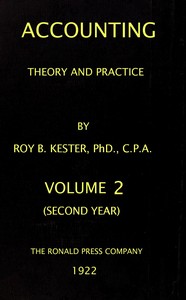
Accounting theory and practice, Volume 2 (of 3) : a textbook for colleges and…
Let's be clear from the start: this is a textbook. Published in the 1920s, it was meant for college students and budding professionals. There's no protagonist or villain, unless you count unbalanced trial balances. The 'story' is the logical progression of accounting concepts beyond the basics.
The Story
Volume 2 picks up where introductory accounting leaves off. Kester systematically walks through more complex topics. He explains how to handle corporate accounting—issuing stock, dealing with dividends, and handling surplus. He dives into the intricacies of bonds and long-term liabilities. A big chunk of the book is devoted to understanding and analyzing financial statements. He teaches you how to look at a balance sheet or an income statement and really understand what it's saying about a company's health. It's all about moving from simply recording transactions to interpreting what they mean.
Why You Should Read It
You should read this not to learn current tax law (a lot has changed!), but to understand the why behind the how. Kester's writing is direct and surprisingly accessible. He has a gift for explaining complicated ideas in a step-by-step way. Reading it today, you get a real sense of the principles that haven't changed. The core idea that financial records should present a 'true and correct' view of a business is argued here with conviction. It's also a fascinating look at the pre-computer era. The methods are manual, the examples are of businesses from a century ago, and it gives you a huge appreciation for the accountants of the past.
Final Verdict
This book is perfect for a few types of people: history buffs interested in early 20th-century business, current accounting students who want to see where their field's core teachings came from, or writers researching the period. It's not a page-turner for everyone, but for the right reader, it's a quiet, insightful conversation with a master teacher from the past. Think of it less as a manual and more as a primary source on the philosophy of numbers.
This is a copyright-free edition. You can copy, modify, and distribute it freely.
David Lopez
6 months agoMy professor recommended this, and I see why.
Mary Harris
1 year agoSurprisingly enough, the storytelling feels authentic and emotionally grounded. A true masterpiece.
Kevin Harris
9 months agoTo be perfectly clear, it creates a vivid world that you simply do not want to leave. A valuable addition to my collection.
Lisa Jackson
11 months agoI came across this while browsing and the depth of research presented here is truly commendable. A valuable addition to my collection.

Mason Brown
1 year agoHonestly, the emotional weight of the story is balanced perfectly. I learned so much from this.