
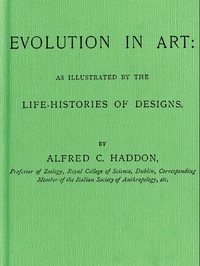
Evolution in Art: As Illustrated by the Life-histories of Designs by Haddon
Published in 1895, Alfred Haddon's Evolution in Art isn't your typical art book. It doesn't talk about famous painters or grand movements. Instead, it asks a simple, powerful question: why do decorative patterns from completely different parts of the world look so much alike?
The Story
Haddon was an anthropologist who studied people in places like the Torres Strait. He collected artifacts and paid close attention to their decorations. He noticed that a spiral pattern in New Guinea might look a lot like one from ancient Greece. His big idea was to borrow a concept from his friend Charles Darwin. He argued that artistic designs aren't static; they have a 'life-history.' A design starts as a realistic drawing of something important, like a bird, a crocodile, or a leaf. Over time, as it's copied and passed down, it gets simplified, stylized, and mixed with other ideas. The original meaning fades, leaving behind an abstract pattern. The 'plot' of the book is Haddon tracing these family trees of patterns. He shows, step-by-step with lots of drawings, how a recognizable animal can slowly turn into a set of geometric lines that no longer looks like an animal at all.
Why You Should Read It
This book is a thrill for anyone curious about the 'why' behind the things we make. It connects dots you didn't know were there. Haddon makes you see that the zigzags on your sweater, the spirals on an ancient Celtic stone, and the motifs on a Pacific Islander's shield might be distant cousins. It's a humbling reminder of our shared human impulse to decorate and find meaning in shapes. Reading it feels like getting a secret decoder ring for visual culture. You start spotting these evolutionary links everywhere. It's also a fascinating snapshot of 19th-century thinking, full of the excitement of applying new scientific ideas to human culture.
Final Verdict
Perfect for history buffs, artists, designers, or anyone who loves a good idea that makes you see the everyday world differently. It's not a long or difficult read, but it's packed with thought-provoking examples. If you've ever enjoyed books like Guns, Germs, and Steel that look for the big patterns in human history, but from a visual and artistic angle, you'll find this a fascinating and foundational little book. Just be ready for your next museum visit to take twice as long—you'll be too busy hunting for the evolutionary stories hidden in the patterns.
This title is part of the public domain archive. Knowledge should be free and accessible.
Aiden Torres
3 weeks agoSimply put, the emotional weight of the story is balanced perfectly. I will read more from this author.
John Robinson
1 year agoGreat read!





Mason Hill
1 year agoThe formatting on this digital edition is flawless.