
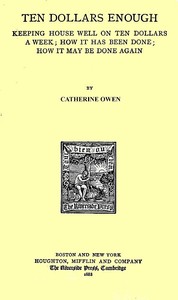
Ten Dollars Enough: Keeping House Well on Ten Dollars a Week by Catherine Owen
Imagine someone telling you they could feed, clothe, and maintain a lovely home for a family today on $300 a week. You'd call them crazy, right? That's the exact challenge Catherine Owen took on in 1889 with Ten Dollars Enough. This isn't a storybook with characters and a plot in the usual sense. Instead, the 'story' is Owen's year-long experiment and her passionate argument for intelligent housekeeping.
The Story
The book is structured as a practical guide, walking the reader through a full year. Each chapter covers a month. Owen lays out her exact weekly budget—that firm ten dollars—and then details how she spends it. She provides daily menus (expect a lot of soups, breads, and creative leftovers), shopping lists noting prices per pound, and meticulous cleaning routines. The 'conflict' is her battle against waste, inefficiency, and the notion that a tight budget means a dreary life. She shows how to make a luxurious-seeming mutton broth from bones, how to economize on fuel, and how to keep a home spotless without expensive help. The narrative drive comes from her confident, sometimes feisty, voice as she proves her point week after week.
Why You Should Read It
I picked this up out of historical curiosity, but I was completely drawn in by Owen's voice. She's sharp, witty, and takes immense pride in her work. Reading this today is a profound reality check. It connects you viscerally to the sheer physical and mental labor of daily life before supermarkets and washing machines. You gain a deep appreciation for the skill our great-grandmothers had to possess. Beyond the history, there's a timeless philosophy here about mindfulness with money, the value of making things yourself, and finding dignity and artistry in everyday tasks. It made me think hard about my own habits of consumption and waste.
Final Verdict
Perfect for history lovers, especially those interested in women's history and social history. It's also a fascinating read for anyone into cooking, frugal living, or simple life blogs—this is the original blueprint. If you enjoy shows about Victorian life or pioneer living, you'll find the same gritty, detailed logistics here. Fair warning: it's a product of its time in some attitudes, but as a primary source document and a testament to human ingenuity, it's absolutely captivating. Don't expect a novel; expect a time capsule and a masterclass in making do.
The copyright for this book has expired, making it public property. You are welcome to share this with anyone.



Ethan Young
1 year agoEssential reading for students of this field.