
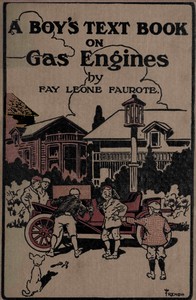
A boy's text book on gas engines : a book for boys describing and explaining…
Let's be clear from the start: this is not a novel. There's no sweeping plot or cast of characters. Instead, the 'story' here is the logical, step-by-step unveiling of mechanical truth. Fay Leone Faurote, writing in 1910, acts as your guide. He starts with the very basics—what is a gas engine, and why is it different from a steam engine?—and then methodically builds your understanding from the ground up.
The Story
The book's structure is its narrative. Each chapter introduces a new component or principle. You 'meet' the cylinder, the piston, the flywheel, and the ignition system. Faurote explains the four-stroke cycle (intake, compression, power, exhaust) with simple diagrams and even simpler language. The conflict is the engine's own operation: how to reliably create a controlled explosion to produce motion. The resolution is the elegant, interlocking dance of all its parts. It’s a story of cause and effect, where fuel, air, spark, and timing come together in a satisfying mechanical symphony.
Why You Should Read It
What's truly captivating is the book's voice. It's confident, direct, and assumes you're intelligent and eager to learn. There's a palpable excitement about this modern technology. Reading it, you get a real sense of how revolutionary and accessible these engines felt at the time. It demystifies technology in a way few modern guides do. You're not just told what happens; you're shown why it has to happen that way. For anyone who likes to understand how things work, it’s incredibly satisfying. It turns a complex machine into a series of solvable, understandable puzzles.
Final Verdict
This book is a hidden gem for a specific reader. It's perfect for history buffs, antique machinery enthusiasts, or anyone with a foundational curiosity about engineering. It’s also a fantastic primary source for writers or creators setting stories in the early industrial age. While the title says 'for boys,' its clear explanations are for anyone. Just know what you're getting: a concise, well-written technical manual from 1910. If you approach it as a fascinating historical document and a lesson in clear explanation, you'll be rewarded with a genuine connection to the mechanical mind of a past era.
No rights are reserved for this publication. It is now common property for all to enjoy.
James Williams
11 months agoGood quality content.







Deborah Walker
1 year agoA bit long but worth it.