
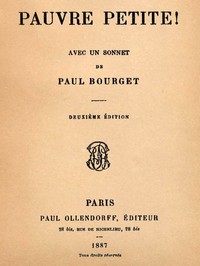
Pauvre petite! by Paul Bourget
Let's talk about 'Pauvre petite!' It’s a classic French novel from 1884, but don’t let that scare you off. It reads like a tense, intimate character study.
The Story
Albert, a successful and somewhat smug writer, meets Fanny, a stunning young woman with a scandalous past. He's immediately drawn to her, but not in a purely romantic way. He pities her. He sees her as a beautiful ruin, a 'poor little thing' destroyed by the fast life of Paris. Convinced of his own superior morality and intellect, Albert decides his mission is to rescue her. He wants to erase her past, reshape her character, and mold her into his ideal of a pure, devoted woman through the power of his love. The story follows this unsettling project, watching as Albert's rigid plans clash with Fanny's complex humanity.
Why You Should Read It
This book hooked me because it’s so psychologically honest. Bourget doesn’t make Albert a villain; he makes him tragically, believably arrogant. You wince at his certainty that he knows what's best. Fanny, meanwhile, is more than just a victim. She’s a real person caught between who she was, who she is, and who Albert insists she must become. The tension isn't about will-they-won't-they, but about whether this kind of 'salvation' is even possible—or if it's just another form of possession. It’s a stark look at the imbalance of power in relationships and the danger of loving an idea of someone instead of the actual person.
Final Verdict
This is perfect for readers who love character-driven stories that explore the darker corners of human motivation. If you enjoyed the psychological tension in novels like Henry James's 'Portrait of a Lady' or the uncomfortable social observations in Edith Wharton's work, you’ll find a lot to chew on here. It’s also a great, accessible entry point into 19th-century French literature. Just be ready for a story that’s more about uneasy questions than easy answers.
This masterpiece is free from copyright limitations. You can copy, modify, and distribute it freely.
Andrew Garcia
1 year agoVery interesting perspective.
Sandra King
1 year agoI didn't expect much, but the depth of research presented here is truly commendable. Definitely a 5-star read.
Brian Wright
6 months agoHaving read this twice, the narrative structure is incredibly compelling. Don't hesitate to start reading.



Mark Taylor
6 months agoUsed this for my thesis, incredibly useful.