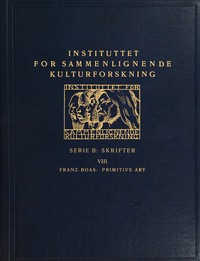
Primitive art by Franz Boas
Franz Boas's Primitive Art isn't a novel with a plot, but it has a clear mission: to dismantle a widespread and harmful idea. The 'story' is the journey of Boas's argument against the evolutionary view of culture that was dominant in his time. This view claimed that societies evolved in a straight line from 'savagery' to 'civilization,' and that their art followed the same path. 'Primitive' art was seen as childish, unskilled, and simple—a mere stepping stone to 'real' art like European classics.
The Story
Boas fights this notion on every page. He doesn't just tell you it's wrong; he shows you. He takes you on a tour of Indigenous art from the Pacific Northwest, Africa, and beyond, analyzing everything from the symbolic patterns on blankets to the complex structures of masks. He demonstrates that what looks 'simple' is governed by strict artistic principles, deep cultural knowledge, and breathtaking technical skill. The book systematically proves that artistic complexity exists everywhere. The real conflict isn't in the art itself, but in the biased lens through which Western observers were (and sometimes still are) looking.
Why You Should Read It
You should read this because it gives you a superpower: the ability to see art on its own terms. Boas teaches you to ask not 'Why isn't this like a Michelangelo?' but 'What is this artist trying to communicate within their own world?' It’s a profoundly respectful approach. When he breaks down how a formline design on a totem pole works, you feel the genius of it. The book argues that art is a universal language, but the grammar changes from place to place. Understanding that grammar is the key to appreciating the art's true beauty and meaning.
Final Verdict
This is a foundational text, so it’s perfect for curious readers who love art history, anthropology, or just questioning why we think the way we do. It's for the person who visits a museum's 'global arts' wing and wants to go deeper than the label on the wall. Be warned, the writing is from the 1920s and can feel dense in spots—it’s not a breezy beach read. But the core ideas are crystal clear and incredibly liberating. If you want to permanently retire the word 'primitive' from your vocabulary and see human creativity in a richer, fairer light, this book is essential.
This digital edition is based on a public domain text. It is available for public use and education.