
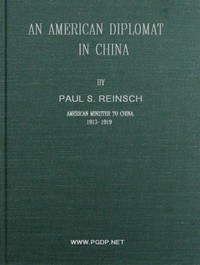
An American Diplomat in China by Paul S. Reinsch
Let's set the scene: It's 1913. Woodrow Wilson is president, and he sends a smart, idealistic professor named Paul Reinsch to be the U.S. Minister to China. Reinsch isn't a career politician; he's a guy who genuinely believes in China's potential. He arrives as the ancient Qing Dynasty has just collapsed, and a new republic is trying, shakily, to stand up.
The Story
This isn't a novel with a single villain. The story Reinsch tells is about navigating a political minefield. His main job is to support China's fragile new government and protect its sovereignty. The big problem? World War I kicks off in Europe, and Japan, an ally of Britain, sees its chance. While the Western powers are distracted, Japan presents China with the infamous 'Twenty-One Demands'—a list that would essentially turn China into a Japanese protectorate. Reinsch spends years fighting a diplomatic war, sending urgent cables to Washington, trying to rally support to push back against Japan. He becomes China's most vocal foreign advocate. But the climax is a quiet, devastating betrayal. In 1917, the U.S. needs Japan's help in the war, and in a series of secret agreements, American officials agree not to interfere with Japan's interests in China. Reinsch's life's work is undermined by his own government. He resigns in 1919, a broken man, watching the peace conference in Versailles hand German territories in China over to Japan instead of returning them to the Chinese.
Why You Should Read It
You should read this because it turns history from a list of dates into a human drama. Reinsch's writing is clear and surprisingly emotional. You feel his initial excitement, his growing frustration, and his final despair. The book is a masterclass in how geopolitics really works—not in grand speeches, but in backroom deals and calculated silences. It also gives Chinese figures like President Yuan Shikai a voice and complexity often missing from Western narratives of this era. Most importantly, it shows the birth of modern Chinese nationalism. The betrayal at Versailles, which Reinsch witnessed, directly sparked the May Fourth Movement, a pivotal moment that shaped China's 20th century. You're not just reading about diplomacy; you're reading the origin story of a national trauma.
Final Verdict
This book is perfect for anyone who loves political drama, real-life spy novels (without the spies), or understanding the roots of today's world. It's for history buffs who want to go beyond textbooks and hear from someone who was in the room. It's also surprisingly relevant for anyone curious about why U.S.-China relations are so fraught with mistrust—you can trace a direct line from the disappointments of 1919 to the tensions of today. A word of advice: it's a primary source, so it's dense in parts. But push through the occasional long report; the personal story at its heart is utterly gripping and unforgettable.
This digital edition is based on a public domain text. Knowledge should be free and accessible.
Joseph Allen
10 months agoRecommended.
Paul Ramirez
1 month agoAfter finishing this book, the character development leaves a lasting impact. Truly inspiring.
Charles Lopez
1 year agoFive stars!




John Williams
1 year agoAfter finishing this book, the clarity of the writing makes this accessible. One of the best books I've read this year.