
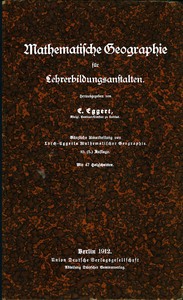
Mathematische Geographie für Lehrerbildungsanstalten by Erwin Eggert
Let's be clear from the start: Mathematische Geographie für Lehrerbildungsanstalten is not a novel. It's a textbook written in 1912 by Erwin Eggert, specifically for students training to become teachers in the German system. So, there's no plot in the traditional sense. Instead, the 'story' is the logical progression of ideas Eggert lays out to build a future teacher's understanding of mathematical geography.
The Story
The book walks you through the fundamental concepts a teacher would need to explain how the Earth works, mathematically. It starts with the basics—the shape of the Earth, latitude and longitude, and how to represent a sphere on a flat map. Then, it builds on that foundation to explain time zones, the reasons for the seasons, and the patterns of climate. It's a step-by-step manual. Eggert presents a concept, often with diagrams and calculations, showing exactly how to demonstrate it. The goal wasn't to create geography experts, but to equip teachers with a solid, understandable framework they could then pass on to their own students.
Why You Should Read It
You should read this not for cutting-edge science, but for historical perspective. It's a masterclass in clear, structured teaching from a bygone era. Eggert's writing is direct and purposeful. There's a palpable sense of duty—he is building the foundation for generations of schoolchildren. What I find most compelling is seeing what was considered core, essential knowledge. The focus is on universal principles (like planetary motion) rather than political boundaries that change. It's also a humbling reminder of how much we take for granted. Today, we can pull up a 3D globe on our phones; Eggert's readers had to truly visualize these concepts from text and simple drawings.
Final Verdict
This book is a niche treasure. It's perfect for history of education buffs, vintage science enthusiasts, or anyone fascinated by how people understood their world before the space age. It's also great for teachers today who want to reflect on the timeless principles of their craft. You won't find thrilling adventures here, but you will find a quiet, impressive blueprint for building geographic literacy from the ground up. Think of it less as a book to read cover-to-cover, and more as a museum exhibit you can browse, appreciating the careful thought that went into educating the educators of the early 20th century.
This title is part of the public domain archive. You are welcome to share this with anyone.
Michelle Anderson
1 year agoCompatible with my e-reader, thanks.
Oliver King
2 months agoWow.



Elijah Sanchez
1 year agoAs someone who reads a lot, the content flows smoothly from one chapter to the next. I learned so much from this.